IICRC Water Damage Standards — What They Mean for Your Bellevue Home
When you hire a water damage restoration company in Bellevue, you’re trusting them to follow science — not just run some fans and hand you a bill. The IICRC S500 Standard is the document that defines what professional restoration actually looks like. Here’s what it means for your home and your insurance claim.
What Is the IICRC?
The Institute of Inspection, Cleaning and Restoration Certification (IICRC) is the nonprofit standard-setting body for the cleaning and restoration industry. Based in Las Vegas with global reach, the IICRC publishes the technical standards that define best practices for water damage restoration, mold remediation, carpet cleaning, and fire and smoke restoration. Their standards are ANSI-accredited — meaning they’ve been reviewed and approved through the American National Standards Institute’s process.
The IICRC doesn’t license contractors. It certifies individual technicians and firms through training programs and ongoing education requirements. When a company says “we’re IICRC certified,” that means specific technicians on their team have passed IICRC coursework and exams — not just that someone in the office attended a seminar once.
The S500 Standard — The Rulebook for Water Damage Restoration
The IICRC S500 Standard for Professional Water Damage Restoration is now in its 5th edition (2021). It’s a 200+ page technical document that covers:
- Water damage classification (Categories 1, 2, 3 and Classes 1, 2, 3, 4)
- Health and safety requirements for technicians and occupants
- Psychrometric principles — the science of air, moisture, and drying
- Documentation requirements for insurance claims
- Equipment sizing and placement standards
- Antimicrobial application protocols
- Drying goals and confirmation procedures
In plain terms: it’s the standard that answers the question “how do I know the job was done right?” Insurance carriers, property managers, and attorneys all reference S500 when evaluating whether a restoration job meets industry standards. If your restoration company isn’t following it — whether they know the standard or not — your insurance claim and your home’s structural integrity are both at risk.
Key S500 Concepts Every Bellevue Homeowner Should Know
Psychrometrics — Why the Air Matters as Much as the Wall
Psychrometrics is the science of air properties: temperature, relative humidity (RH), specific humidity (grains per pound or GPP), and dew point. When drywall gets wet, the moisture doesn’t just sit in the material — it evaporates into the air. If the air in the room reaches saturation (100% RH), evaporation stops completely, and drying stops. Industrial dehumidifiers lower the RH of the air, maintaining the vapor pressure differential that pulls moisture out of materials and into the air to be captured.
S500-compliant restoration involves daily psychrometric readings logged in a moisture report. Without those readings, a technician is guessing whether the air is dry enough for materials to continue evaporating. In Bellevue’s fall climate — where outdoor RH regularly runs 80–90% — bringing unconditioned outdoor air in through open windows actively slows drying rather than helping it. This is a mistake we see frequently in DIY attempts on Eastside homes.
Drying Goals — What “Dry” Actually Means
S500 defines dry standard as reaching moisture content comparable to unaffected materials in the same structure. For wood framing, that’s typically ≤16–19% moisture content (MC), depending on species and ambient conditions. For concrete, it’s an equilibrium with the room’s ambient RH. The job isn’t done when the materials feel dry to the touch — it’s done when calibrated moisture meters read at or below dry standard across multiple readings, on multiple days.
This matters for Bellevue homeowners because hardwood floors, engineered wood subfloor, and the cedar siding common on 98006 and 98007 neighborhood homes all have different dry standards and different drying curves. Stopping equipment early on an engineered wood subfloor can leave 3–8% excess moisture trapped in the inner laminations — invisible to the touch, but enough to cause cupping, buckling, or mold growth over the following weeks.
Scope of Work and Documentation
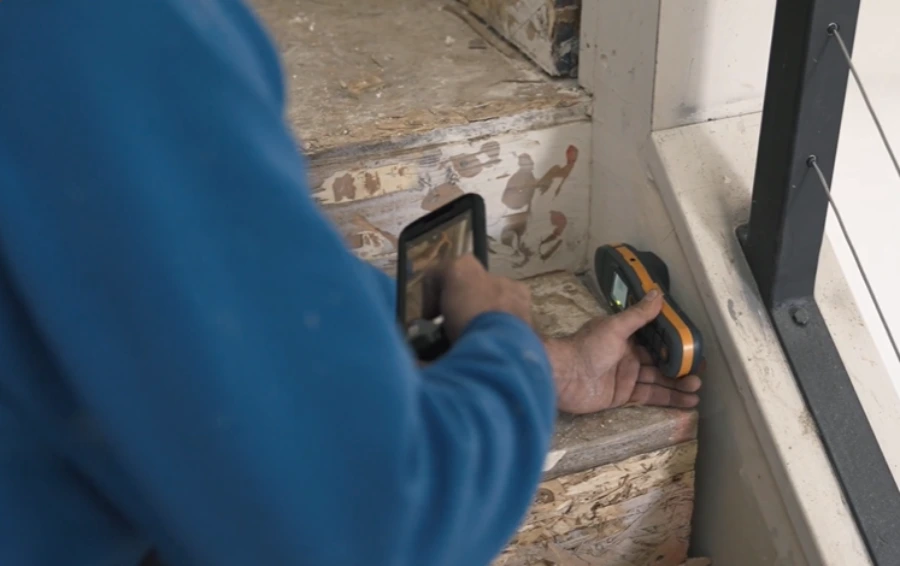
S500 requires a documented scope of work that includes: the classification of water damage, a moisture map of affected areas, equipment logs (type, number, placement of each dehumidifier and air mover), daily psychrometric readings, and final clearance documentation. This packet is what your insurance adjuster needs to authorize payment — and it’s what protects you if the adjuster disputes the scope or timeline after the job is done.
We provide this documentation to every Bellevue client and transmit it directly to their insurance carrier. If a restoration company you’re considering cannot describe this documentation process, find someone else.
IICRC Certifications — What to Look For
There are several relevant certifications for water damage restoration. The two most important:
- WRT — Water Damage Restoration Technician: The foundational certification. Covers water damage categories and classes, extraction techniques, drying equipment, and OSHA safety requirements. Every technician who sets foot in your home for a water loss should hold a current WRT.
- ASD — Applied Structural Drying: The advanced certification. Covers psychrometrics, structural drying calculations, equipment sizing, and documentation procedures. If a company doesn’t have any ASD-certified technicians, they’re not equipped to handle anything beyond a Class 1 loss.
Other relevant certifications for complex or secondary damage:
- AMRT — Applied Microbial Remediation Technician: Required for S520-standard mold remediation when mold is confirmed following water damage.
- FSRT — Fire and Smoke Restoration Technician: For combined fire and water events, common after kitchen fires and sprinkler activations.
You can verify any technician’s active certifications at the IICRC’s public directory at iicrc.org. We encourage Bellevue homeowners to do this — ours are current, and legitimate companies will welcome the check.
The S520 Standard — When Mold Follows Water Damage
The IICRC S520 Standard for Professional Mold Remediation is the companion standard that takes over when water damage leads to confirmed mold growth. In the Pacific Northwest, S520 work is unfortunately common: the combination of elevated ambient humidity, mild temperatures, and the wood-frame construction prevalent across Bellevue’s residential stock creates ideal conditions for mold establishment when moisture events aren’t remediated within 48–72 hours.
S520 requires containment, HEPA air scrubbing, negative air pressure in affected areas, and clearance testing by an independent hygienist before the job is considered complete. If a restoration company is performing mold work and doesn’t reference S520 or AMRT certifications, that’s a significant red flag — particularly for insurance purposes.
Why IICRC Certification Matters for Your Insurance Claim
Washington State insurance carriers — Pemco, Farmers, State Farm, Allstate, USAA, and others active in the Bellevue market — routinely use S500 compliance as a benchmark when reviewing restoration claims. Specifically:
- If drying documentation doesn’t match S500 standards, an adjuster can challenge whether the scope was necessary
- If a non-certified contractor performed work, some carriers will reduce or deny payment for that portion of the claim
- If mold develops after a “completed” restoration job and the documentation shows inadequate drying, the homeowner may be liable for remediation costs that exceed their deductible
The practical upshot: hiring an IICRC-certified company isn’t just about quality. It’s about protecting your claim and your home’s value.
Questions About Your Bellevue Water Damage Claim?
Our IICRC WRT & ASD certified team provides full S500-compliant documentation for every job. We work directly with your insurance carrier.
Frequently Asked Questions — IICRC Standards and Bellevue Water Damage
Does the IICRC certify companies or individual technicians?
The IICRC certifies individual technicians through coursework and exams, and also offers a Certified Firm designation for companies that employ certified technicians and follow IICRC standards. When evaluating a restoration company in Bellevue, ask for the names of their certified technicians and verify their certifications at iicrc.org — the company’s claim of being “IICRC certified” means little without technician-level verification.
Is IICRC certification required by law in Washington State?
Washington State does not legally require IICRC certification to perform water damage restoration work — only a General Contractor license is required for structural repair. However, most insurance carriers expect S500-compliant work and documentation, and many will challenge claims from non-certified contractors. IICRC certification is effectively the industry standard of care, even without a legal mandate.
What is the difference between WRT and ASD certification?
WRT (Water Damage Restoration Technician) is the foundational certification covering water damage identification, extraction, and basic drying. ASD (Applied Structural Drying) is the advanced certification covering psychrometrics, equipment sizing calculations, structural drying protocols, and documentation. For any job beyond a small, contained Class 1 loss, you want an ASD-certified technician overseeing the drying phase.
How does the IICRC S500 affect my insurance claim in Washington?
Washington insurance carriers use S500 as a benchmark for evaluating whether restoration work was necessary and properly performed. S500-compliant documentation — moisture logs, equipment records, psychrometric readings, clearance reports — gives adjusters the evidence they need to authorize payment without dispute. Without it, you may face delays, scope challenges, or partial denials even for legitimate claims.